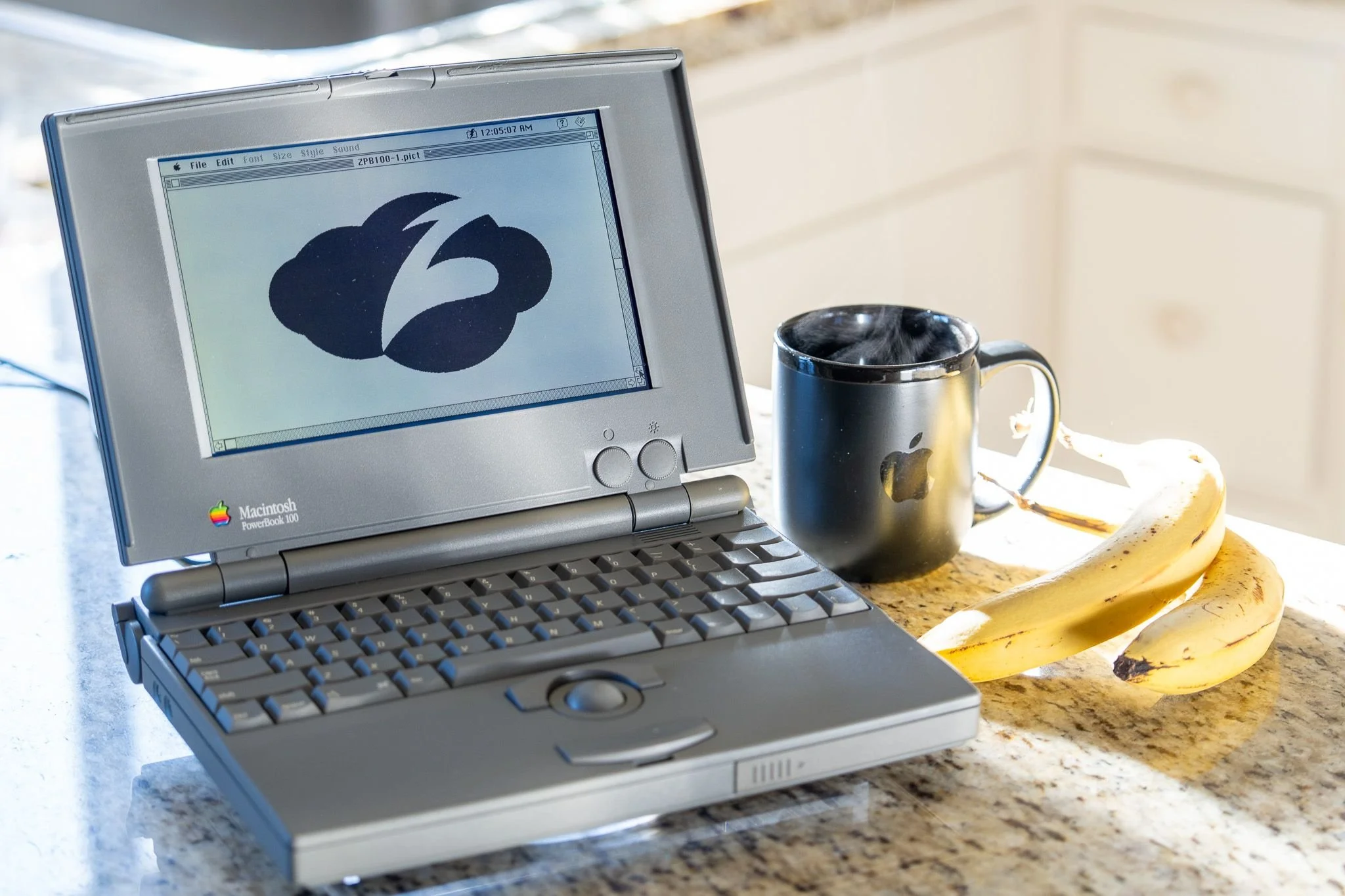
Apple PowerBook 100
For the first “Zscaler Logo on a Weird, Old, or Obsolete Device” of 2026, I give you one of the most influential computers of all time: the legendary Apple Macintosh PowerBook 100!
As I shared a couple years ago, Apple’s first “laptop” (or more accurately, “luggable”) was the Macintosh Portable. The Mac Portable got some things right (active matrix display, fantastic keyboard, literally every feature found on a desktop Mac), its staggering size, weight, and high price basically doomed it from the start.
Disappointed by the failure of the Mac Portable but determined to get it right with their next attempt, Apple formed a partnership with Sony. Apple led the industrial design for the new machine while Sony applied every possible trick to make it smaller, less power-hungry, and cheaper to manufacture than the Mac Portable. The result of this collaboration was the PowerBook 100, which debuted in October 1991.
Apple and Sony made some wise choices when they reimagined what a portable Mac should be:
They replaced the brilliant but expensive active matrix LCD screen with far cheaper passive-matrix display
They removed the internal floppy drive and integrated a smaller 2.5" hard drive
They reduced the number of ports, redesigned the keyboard to be smaller and lighter, and implemented some advanced power management tricks to extend battery life
The cumulative effect of these design changes are pretty stunning when you compare the this machine to its predecessor from only two years earlier. The PowerBook looks *tiny* compared to a Mac Portable, and it weighs less than 1/3 as much too. In fact, it feels surprisingly modern in 2026 - not something I can say about most of the vintage systems I share here!
However, the most influential design element of the PowerBook 100 was the placement of the trackball in front of the keyboard, which created a natural place to rest your wrists. Although this seems obvious today, this comfortable layout was a new concept in 1991 - pretty much every previous portable computer had placed the keyboard flush with the front edge of the machine (or had a detachable keyboard connected with a cable). Virtually every laptop from the PowerBook 100 through to today has mimicked this layout - a legacy of user-friendly design that literally redefined the entire experience of using a portable computer.
Running at only 16MHz and limited to a maximum of 8 megs of RAM (mine has 4), the PowerBook 100 wasn’t a speed demon. However, by aggressively correcting their mistakes and totally rethinking the entire concept of what a portable computer could be, the PowerBook 100 literally set the template that we’re all still enjoying today. Don’t just take my word for it either - the PowerBook 100 sits on many lists of the best and/or most important computers of all time.
That’s it for now, but stay tuned - I’ve got some cool stuff in the pipeline!