Macintosh SE/30
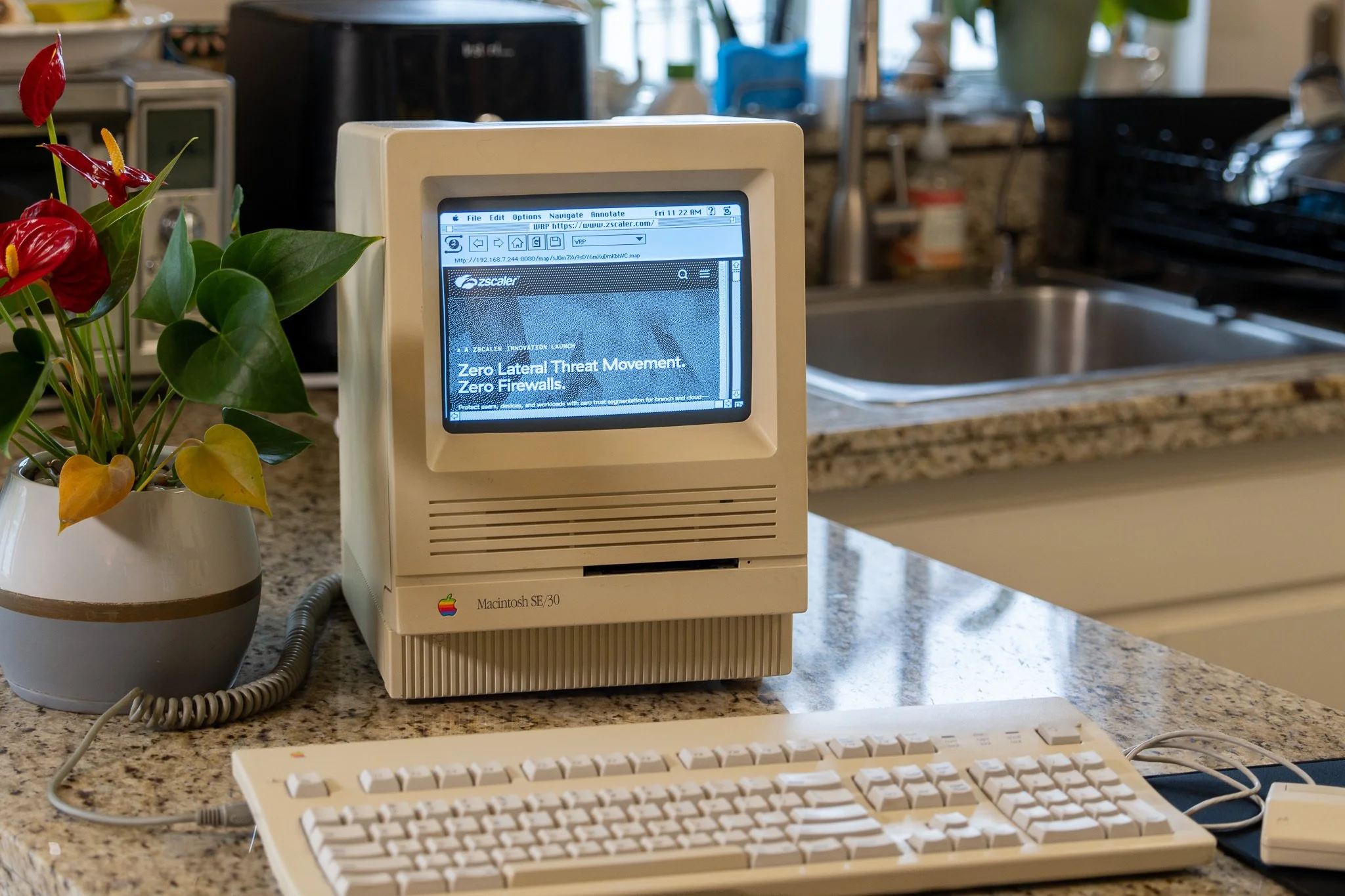
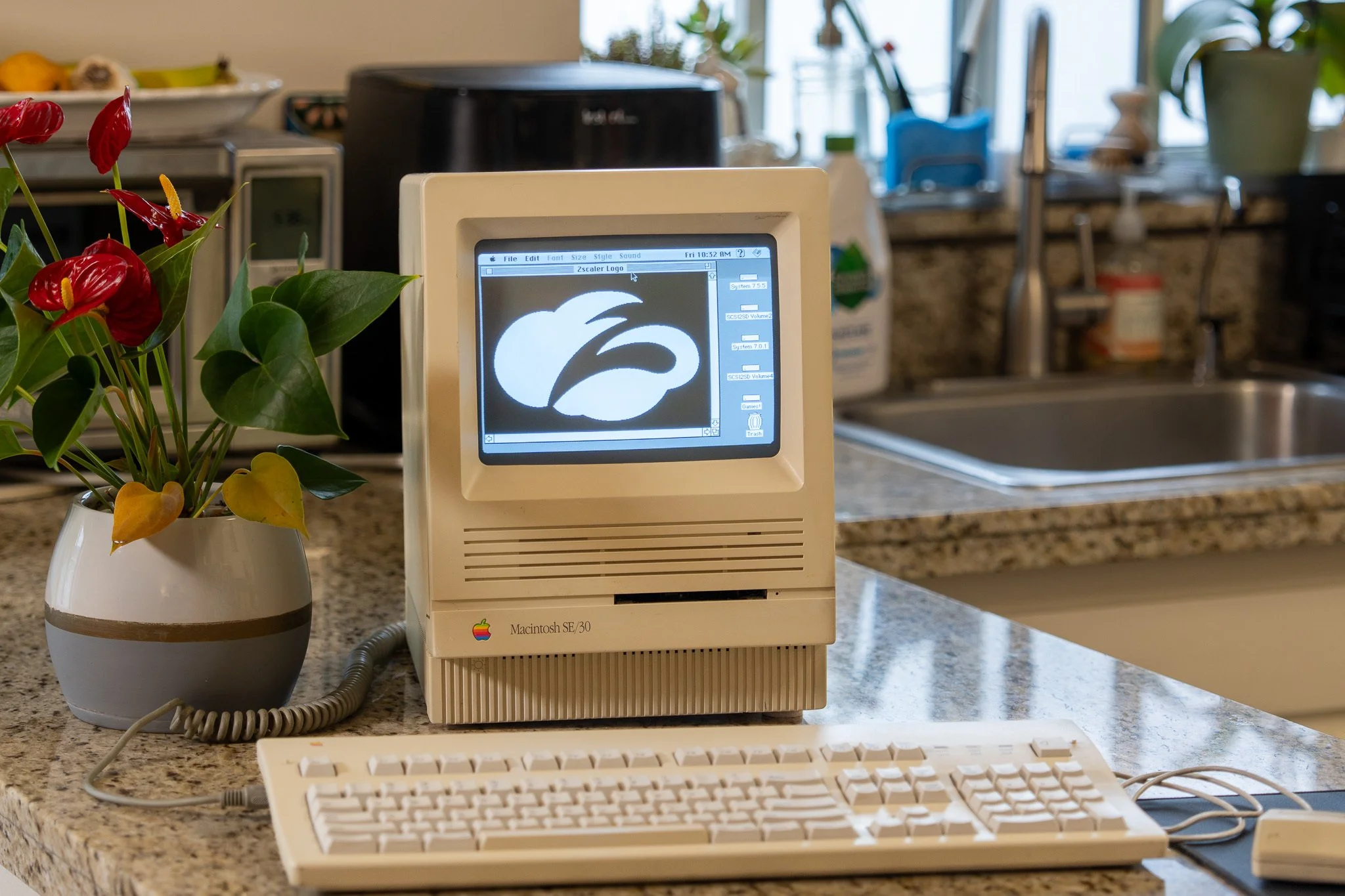
For today’s “Zscaler Logo on a Weird, Old, or Obsolete Device,” I am delighted to bring you one of the most beloved and sought-after vintage computers of all: the legendary Macintosh SE/30!
For many collectors, the Mac SE/30 is the ultimate expression of the original Macintosh ethos. Other “black and white” Macs like the original Macintosh 128k, the Mac Plus, and the Mac Classic were important and influential machines, but they more-or-less maintained the strictly limited expandability that Steve Jobs had imposed from the beginning.
However, Jobs was gone and Apple’s leadership decided to try an experiment: what if we made a little black-and-white Mac, but made it fast and upgradable? The result is this machine from 1989, which combines the compact styling of the earliest Macs with a surprisingly expandable design.
Processor: the SE/30 shipped with a powerful Motorola 68030 processor, making it up to 6X faster than other “black and white” Macs. As a full 32-bit CPU, the 68030 even allows the SE/30 to run A/UX, Apple’s version of UNIX.
RAM: released in an era when most Macs could be upgraded to 4 or even 8 megabytes of RAM, the Mac SE/30 supports up to 128 megs - a staggering amount by the standards of the late 80’s!
Expansion: the SE/30’s motherboard includes the one thing that Steve Jobs banned from the original Mac: an expansion slot. This “PDS” slot (“Processor Direct Slot”) made it possible for 3rd-party companies to offer a wide variety of internal upgrades and expansions. In a clever bit of engineering, the design allows PDS cards to “pass through” from one to another, meaning that it’s possible to stack multiple cards inside the machine, as long as they physically fit and don’t overload the power supply.
With all this in mind, the SE/30 has become a beloved collector’s item, with hobbyists around the world “hot rodding” them to levels which would have seemed utterly insane in 1989. For example, *my* SE/30 has the following upgrades:
68 megabytes of RAM (I’m tempted to max it out with the full 128!)
A MacCon30 Ethernet PDS card, allowing my SE/30 to join my home LAN and connect to the Internet - that’s how I was able to load the Zscaler homepage in the venerable Mosaic browser!
An Interware Booster PDS card, which replaces the stock 16MHz CPU with a blistering 50MHz chip
An upgraded ROM chip which resolves some limitations in the original ROM, and also turns the “happy Mac” startup icon into a winking pirate
An internal SCSI-to-SD adapter allowing the machine to boot quickly and silently from a microSD card
On a purely personal level, the SE/30 was a milestone for me: I bought one at a thrift store in ~1995, used it extensively for a year or so, and then traded it to a local computer shop for a 14.4Kbps dial up modem. That little US Robotics modem became my first connection to the Internet, opening my mind to possibilities that eventually led to my career. I’m glad to have another SE/30 today, and I’m glad I can share it with you all. Happy Friday!